Lendlease Australia is set on cutting carbon emissions across its investment management, development and construction businesses, saving 40,628 tonnes of carbon in FY22 – enough to power 6,000 Australian homes with renewable energy per year.
The company reported a reduction of 35% in Scope 1 emissions as it works towards its goal of eliminating fossil fuels used on its construction sites, and 49% in Scope 2 emissions, with 59% of the electricity provided for all Lendlease Australia’s operations from renewable sources.
Lendlease is two years into its Mission Zero journey of being a 1.5°C aligned company with bold targets of reaching net zero by 2025, by eliminating Scope 1 and Scope 2 emissions (from the fuel the company burns, and the power consumed), and absolute zero emissions for scopes 1, 2 and 3 by 2040, with no offsets.
The Mission Zero progress report also highlighted that Lendlease’s Construction and Development businesses, Barangaroo assets and Australian Prime Property Fund Commercial (APPFC) managed fund assets are 100% renewably powered.
“Our Australian team is two years into its journey to reach net zero carbon by 2025 and absolute zero by 2040 and we’re now seeing our commitments turn into action as we make real change to urgently eliminate carbon emissions across our business and supply chain.
“By sharing our progress report on working towards our ambitious targets, we’re keeping ourselves accountable to make our goal a reality and hopefully helping others also on the decarbonisation journey. Transformation of our industry to support a 1.5°C future is complex – sharing information is critical to helping the industry learn together and move forward at pace. The steps taken to date are just the beginning and a testament to the dedication, hard work and innovative approaches of our people, clients, consultants, supply chain, industry partners.”
Ann Austin, Head of Sustainability, Lendlease Australia
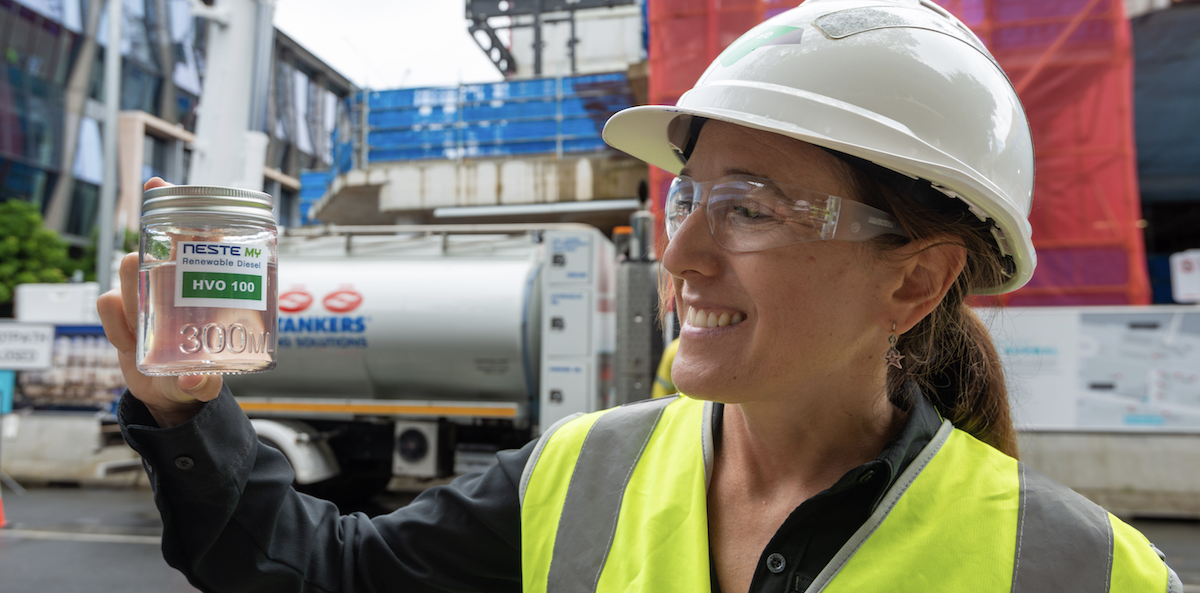
Renewable diesel was introduced at the Powerhouse Paramatta project in Sydney – which is currently under construction – to power tower cranes onsite, reducing greenhouse gas emissions from crane operations by as much as 75 to 95% over the life cycle of the fuel compared to fossil fuel diesel.
At commercial building Victoria Cross Tower, located in North Sydney and under construction, a fully electric operating model has been adopted so it can be powered 100% by renewables, eliminating reliance on fossil fuels and reducing associated emissions.
Low embodied carbon materials were used during construction of residential development One Sydney Harbour and commercial building 555 Collins Street in Melbourne, to reduce the upfront scope 3 emissions.
One Sydney Harbour pioneered the use of low embodied carbon aluminium for the building’s façade, reducing the carbon intensity of the aluminium by 34% and creating an overall 5% reduction in carbon intensity across the entire project.
555 Collins Street used a low carbon cement for the structure on the commercial tower, reducing the structure’s overall embodied carbon by an estimated 30%.
In 2023, Lendlease became a founding member of the Global Cooksafe Coalition, committing to phasing out gas from the kitchens of its new developments by 2030 and delivering all-electric retrofits of assets under management by 2040.
The report acknowledged that Scope 3 emissions (which come from the energy tenants consume and the footprint of materials used) are the most challenging to measure and reduce.
Lendlease Australia is collaborating with tenants to encourage the take up of renewable electricity, and with suppliers to progressively source and procure low embodied carbon materials.
The company is also playing a key role as founding member of the Materials and Embodied Carbon Leaders Alliance (MECLA), collaborating across the building and construction industry to drive reductions in embodied carbon.