


Bouwinvest Real Estate Investors has released insights from its latest ‘Asia-Pacific Living Outlook 2024 – 2026’, highlighting that due to demographic shifts, ongoing urbanisation and evolving lifestyle preferences, demand for living properties continues to outpace supply.
Bouwinvest expect household growth across the region to be positive, at around 1% pa. between 2024 and 2026, aided by an increase in the number of one-person households.
The prime rental age cohort of 25 to 39 years old is expected to show sustained growth in selected markets in Asia-Pacific, and will boost demand for multifamily housing relative to single-family housing (SFH).
Given high price-to-income ratios in the home-ownership markets, the overall trend is that significantly more rental housing is needed, especially in the heavily undersupplied affordable housing segment, according to Bouwinvest.
The share of 80+ inhabitants in Asia-Pacific is expected to increase significantly for countries such as Japan, South Korea and China, boosting demand for care homes.
Moreover, student beds available compared to the total number of students is approximately 5% in Australia. The supply and demand imbalance is expected to be structural, making the case for student housing investment very attractive.
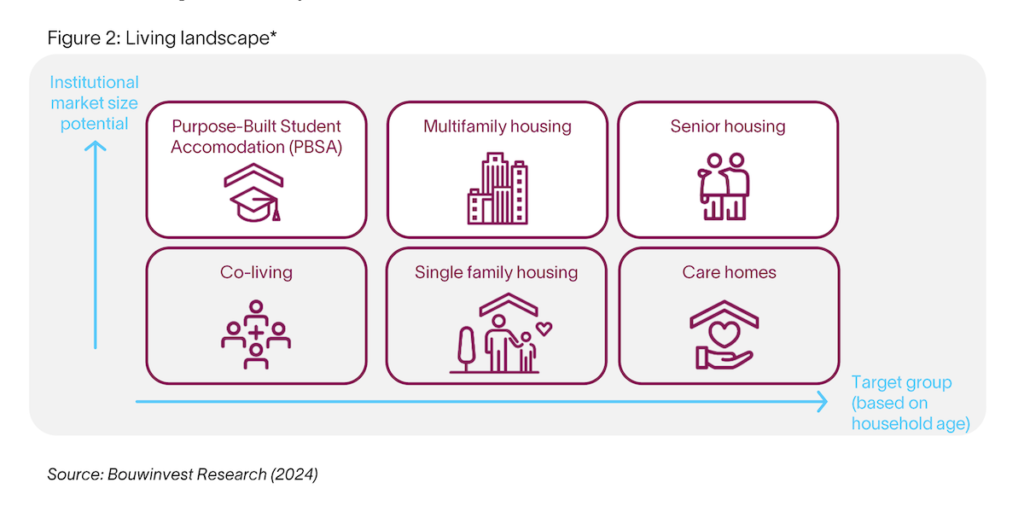
Bouwinvest believes that the outlook for the Asia-Pacific living sector is ‘very promising’. The region accounts for about two-thirds of the world’s population and half of global GDP.
The Asia-Pacific region continues to benefit from strong fundamentals driven by long-term megatrends.
Two in three members of the global middle class will be in Asia by 2030, which is expected to have a positive impact on the growth of other developed APAC countries. GDP growth is projected to outpace the US and Europe over the outlook period.

The Asia-Pacific region is increasingly seen as a ‘core’ region and already accounts for one-third of the global investable universe, including a growing living sector.
The region is marked by the growing importance of sustainability and the increased pace of institutionalisation, according to Bouwinvest.
As a result, Asia-Pacific institutional investors are making a gradual and managed shift from core, traditional real estate sectors to more investments in niche and growth segments of the market.
According to the latest ANREV investment Intentions Survey, together with logistics, the residential sector was the most preferred sector in the Asia-Pacific region in 2024.
Bouwinvest reports that Japan has already established itself as a mature residential for-rent market. Australia is quickly developing its Build to Rent sector, in addition to a flourishing student housing market.
A more favourable fiscal position for Build to Rent investors in Australia is expected to boost the sector and increase investor interest.
Other markets that see growing interest in the living sectors are New Zealand, Singapore and South Korea, where many characteristics of the local market are the same as in other parts of the world, such as the supply and demand imbalance, an expensive home-ownership market and rising rents.


