Urbis has released its latest Australia Living Sectors Market Insights report, revealing that 64% of approved Build to Rent developments nationally have yet to secure funding.
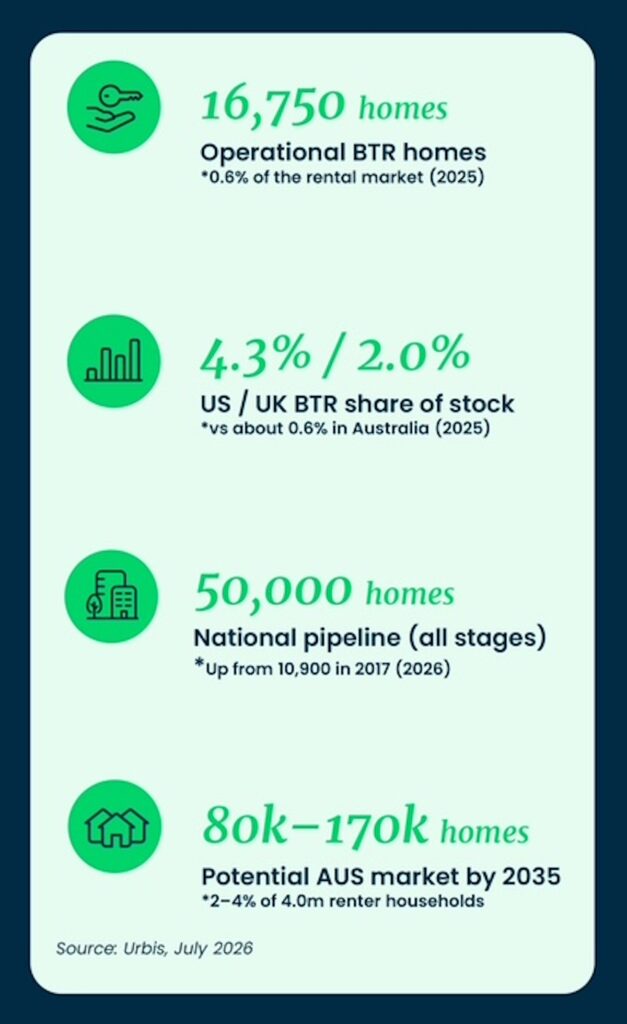
The finding comes despite the sector’s development pipeline growing from 10,900 apartments in 2017 to 50,000 apartments across all stages of development today.
The gap between planned supply and funded projects highlights the challenge of moving developments from approval to delivery. At the same time, the sector continues to add new supply, with 16,750 operational Build to Rent units nationally and 14,200 apartments under construction.
“The Build to Rent sector is entering a more established phase. Rather than continued growth in the pipeline, we’re seeing steady delivery as projects move through construction and into operation.”
Dylan Gray, Director, Urbis
Build to Rent remains a relatively small part of Australia’s rental housing market, accounting for just around 0.6% of the country’s 3.3 million-household rental market.
This suggests significant room for growth, with Australia potentially able to support between 80,000 and 170,000 Build to Rent dwellings by 2035 if the sector follows the trajectory of more mature markets such as the US (4.3% of rental stock) and UK (2.0%).
Therefore, Australia’s growth is following similar trends to institutionalisation seen offshore, where US completions rose by around 148% and UK Build to Rent homes grew by around 59% over three years.
Of the national pipeline of around 50,000 apartments, 14,200 units are currently under construction, pointing to a significant increase in operational stock in the near term, according to Urbis’ report.
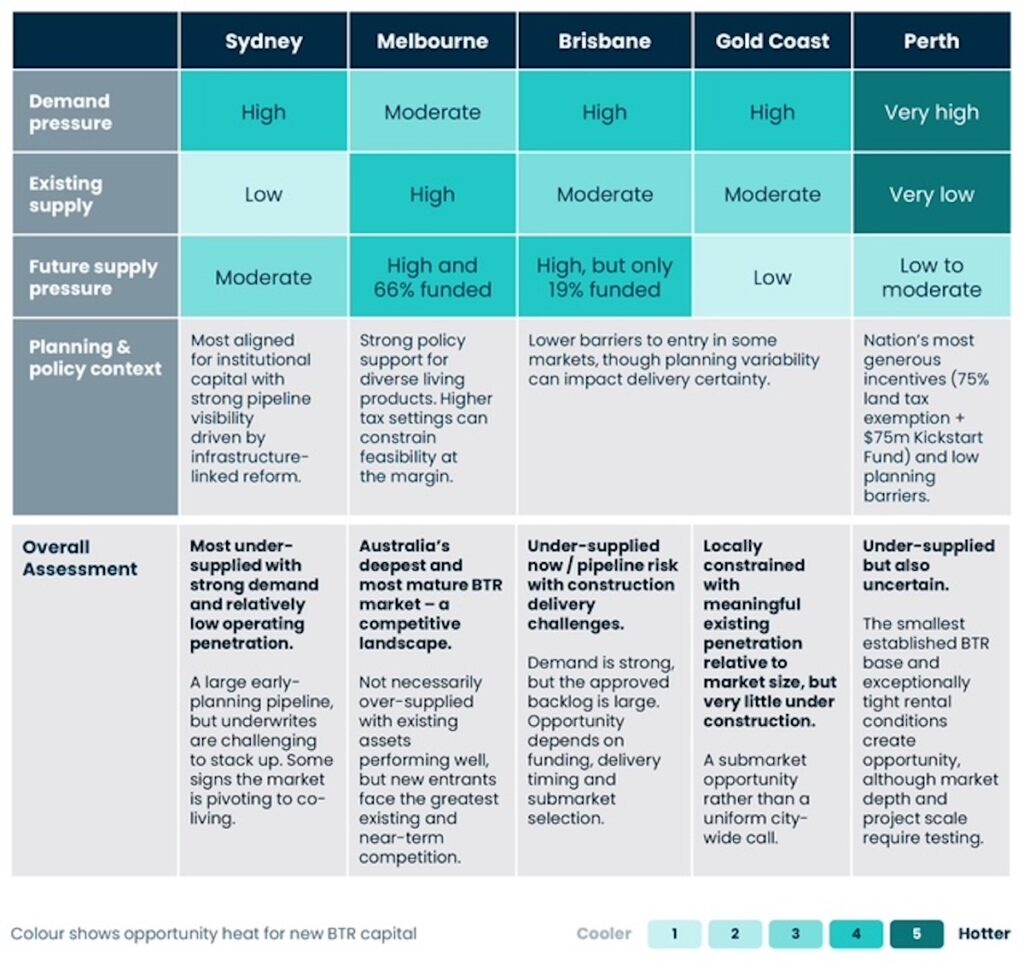
Moreover, Sydney has overtaken Melbourne as the largest forward Build to Rent pipeline, with 11,590 units approved or at application stage, compared with 9,300 units in Melbourne (excluding projects under construction).
Build to Rent accounts for around 4.3% of rental stock in the US and 2.0% in the UK, compared to the approximately 0.6% in Australia. If Australia follows a similar trajectory, the sector could support up to 170,000 dwellings by 2035.