
Property consultancy Savills has released its Australian Multifamily Market & Trends report, summarising that higher specification, efficiently designed, highly curated, sustainable, well located, professionally managed, amenitised developments achieve a higher rental price point than a dissimilar product.
This narrative extends across the entire living sector spectrum; however, Savills’ report focusses on the multifamily market.
Savills analysed currently advertised two-bedroom apartment rents across six newly developed operational multifamily schemes, across six different suburbs of Melbourne, from the CBD to the East, South and West.
High-level analysis sourced from SQM Research compares the median multifamily two-bedroom apartment weekly advertised price with the median two-bedroom weekly advertised price for the suburb in which the scheme is located.
The analysis simply highlights that median multifamily rents have a higher price point compared to the median suburb private rental market rent of between 18 and 26%.
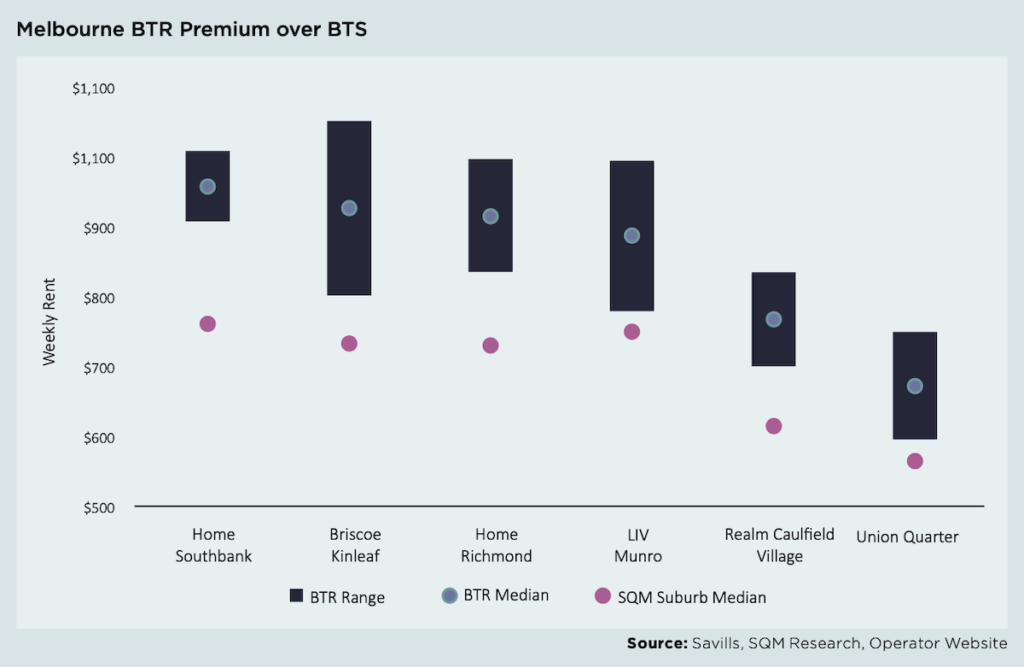
Four schemes have been operational for over a year, and they all report occupancy levels of 90%+ as of end of Q1 2024. The two newly opened schemes – The Briscoe and Union Quarter – both report strong leasing velocity in line with market norms, at advertised pricing, suggesting that the higher price point can be achieved.
This higher rental pricing is largely due to the value-add offering provided to a resident in a multifamily scheme when compared to one in the private rental market. The higher price accounts for the difference in offering.
Multifamily includes accommodation within modern sustainable buildings, utilises advanced technology with sophisticated design, amenity provision (internalised within the development and external retail offering), curated communities, resident-focused services, security of lease tenure – all of which are delivered via professional management and through single (largely institutional) long term ownership.
Multifamily is a different offering to the private rental sector and should be considered that way, and to be treated that way in aspects of policy, planning and taxation.