



Within its latest ‘A Spotlight on Build to Rent Across Australia’ report, property consultancy and solutions provider Urbis has discovered that there has been inconsistency in how existing frameworks have been applied within Policy, Planning, and Taxation for Build to Rent.
Therefore, an increased and inherent risk associated with undertaking a project that has a lack of clarity in how local council will assess plans, and how state specific taxation will be applied, has developed.
Alongside the international inconsistency for Australia from a foreign investment perspective, the industry has concerns on the need to level the playing field and provide consistency across the nation for how these projects are assessed.
This is driven by a desire to reduce risk to a proportionate level, by providing greater certainty and equivalising investment for foreign funds when comparing Australia to other countries, Urbis found.
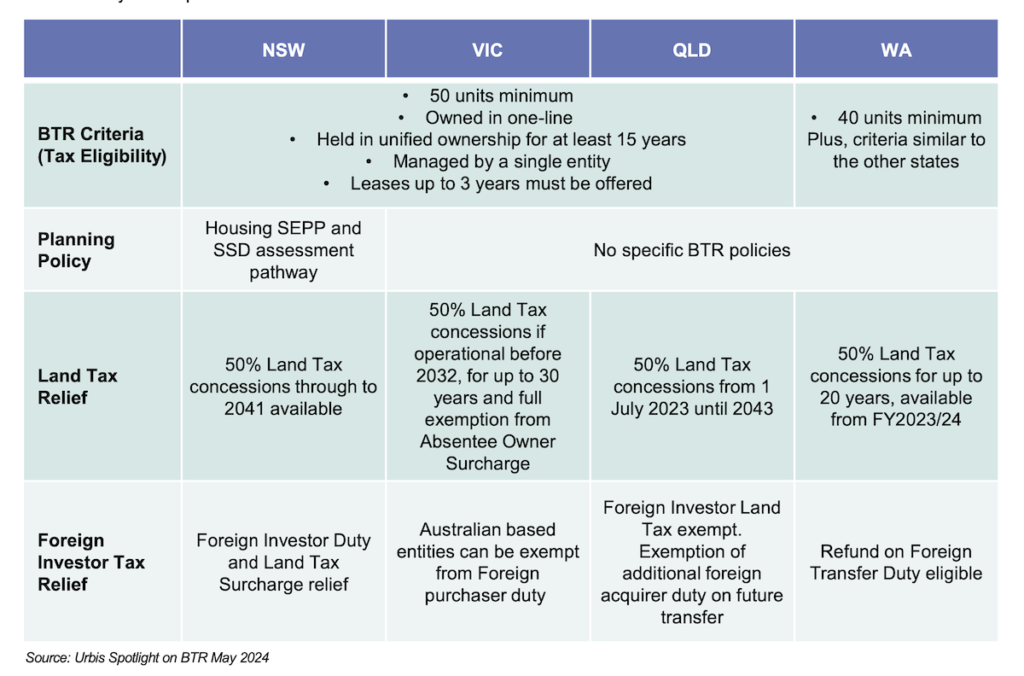
The latest legislation introduced into Federal Parliament improves some of the key national taxation issues, via the lowering of the managed investment trust (MIT) tax to 15% across both capital gains tax and rental income.
The legislation also allows the extension of the time period beyond 15 years for the concessional rate.
However, the tax concessions come with a 10% affordable housing requirement to be offered at a minimum 25% discount to market rent, which may constrain the full viability impact this tax change could have.
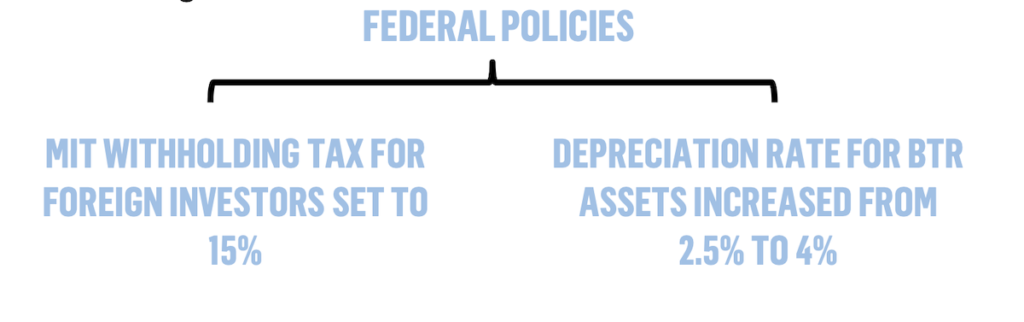
Urbis highlights that from a state perspective, New South Wales has led the way in terms of providing an asset specific planning policy framework for Build to Rent, with the key policy moves to permit the sector in commercial zoned land, flexible application of the Apartment Design Guide, and introducing non-discretionary development standards.
Most recently, City of Sydney LGA has proposed further policy changes to incentivise Build to Rent in Central Sydney. However, despite policy incentives, Build to Rent supply is well below Victoria.
Urbis’ report found that Victoria and Queensland have not yet established a specific land use definition or assessment criteria for Build to Rent, with these elements defaulting to the Build to Sell requirements.
However, individual councils have started making concessions on elements like apartment sizing, private open space, and reduced car parking in recognition of Build to Rent specific development types where there may be larger communal areas or lower rates of car ownership.
In these instances, conditions of approval are usually enforced to ensure approved Build to Rent developments are not able to ‘flip’ to Build to Sell in the future for a minimum period, or in perpetuity.
In Western Australia, there is not currently a separate land use or development criteria for Build to Rent proposals, however, a number have achieved approval without significant issue.
A key consideration is the diversity of the dwelling mix, size of dwellings and car parking provisions. Within the report, Urbis has captured the key policies in Australia’s largest states, where much of the Build to Rent activity is occurring.


