Property consultancy Knight Frank has released its Australia Build to Rent Update Q4 2024 report, which highlights that Australia’s ‘Big Three’ cities – Melbourne, Brisbane and Sydney – will remain the core focus for Build to Rent investors in the current market, with Sydney expected to ‘take the limelight’ for the sector in 2025.
Around 8,900 dedicated Build to Rent apartments are under construction nationally and a further 20,000 units are approved for development over the next five years.
Since 2018, 19,308 Build to Rent units have been delivered or are under construction, while another 40,191 units are planned, with the total coming to just under 60,000.
“Sydney has been slower out of the starting blocks compared to its Victorian counterpart but Build to Rent development activity is now accelerating as investors look to gain a foothold in the city.
“Development challenges are most acute in Brisbane, and we therefore expect new-build supply in this market to lag Melbourne and Sydney in the short term, despite also facing a chronic lack of rental accommodation.
“In time, larger platforms will look to diversify their portfolios with tier two locations, however the ‘Big Three’ cities remain the core focus for investors in the current climate.”
John Paul Stichbury, Partner, Living Sectors, Valuation & Advisory, Knight Frank
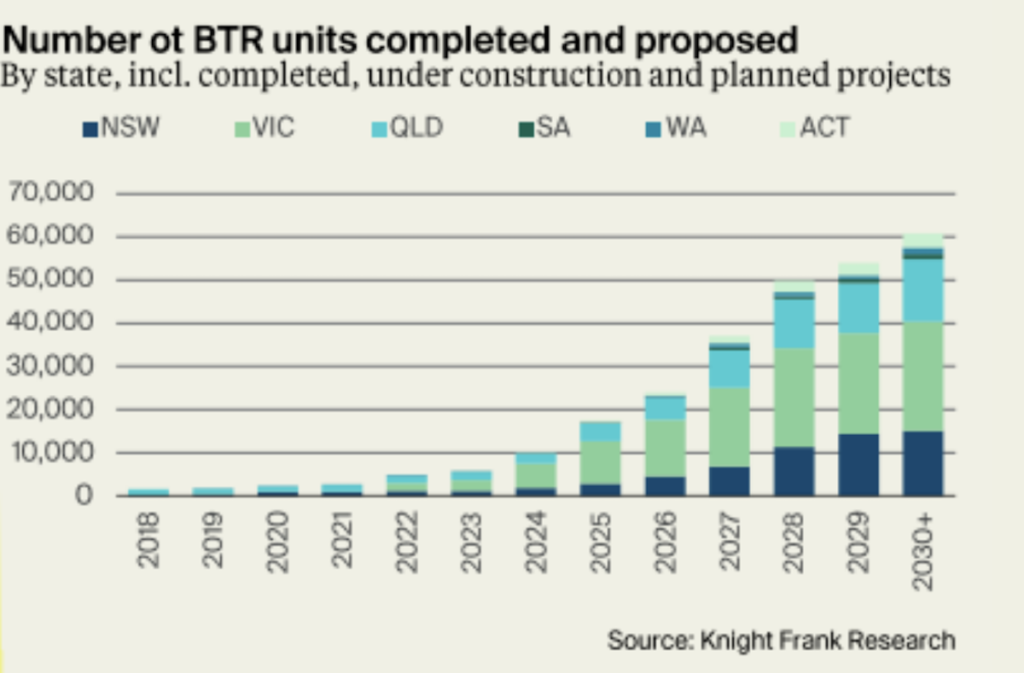
The pipeline is most advanced in Victoria; however, New South Wales is growing fast and has recently overtaken Queensland.
Knight Frank has also found that the investment case for Build to Rent has arguably never been stronger, and this year’s activity will accelerate as Australia enters a rate-cutting cycle.
To date, Victoria has seen 11,098 Build to Rent units either completed or under construction, with another 14,440 in the pipeline totalling 25,538.
In Queensland, 4,157 units have been completed or are under construction, with another 10,233 in the pipeline to total 14,390.
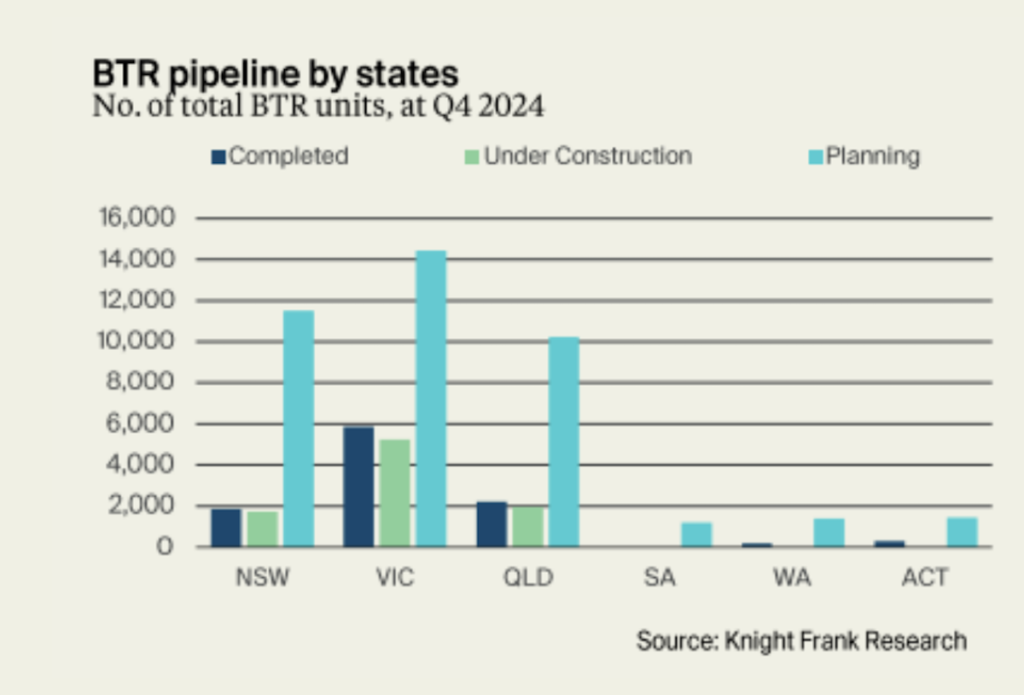
New South Wales has 3,584 completed or under construction and 11,505 in the pipeline, with the total number of Build to Rent units totalling 15,089, which has seen the state recently overtake Queensland.
The ACT has just 1,723 either completed, under construction or planned, while Western Australia has 1,568 and South Australia has 1,191, according to Knight Frank.
“The investment case for Build to Rent has arguably never been stronger and this year activity will accelerate as we enter a rate-cutting cycle. In recent investor surveys, ‘beds’ are often vying with ‘sheds’ for the top spot in preferred sector rankings.
“Investors are gravitating toward living sectors partly because of its defensive characteristics – specifically the ability to adjust rental income streams more quickly than other sectors in response to high inflation.
“However, short-term challenges in the Build to Rent sector persist, with investment volumes in 2024 impacted by the wider macroeconomic environment and uncertainty around government policy, as well as a challenging development market, with the persistent build cost inflation putting pressure on feasibilities.
“Despite these headwinds, there have been some good wins for the sector recently.
“After a long delay, critical legislative reform of Build to Rent tax policy has been passed by parliament.
“This signals to foreign investors that the Australian government supports and recognises Build to Rent as an important component of future housing supply.
“A more favourable policy/investment setting will help to accelerate inwards investment from established global investors.
“This is important as domestic funds continue to largely sit on the fence when it comes to Build to Rent.
“This year we expect strong demand for operational Build to Rent schemes driven by a scarcity factor and appetite for income-producing assets.
“On the development side, stabilising constructions costs will help feasibilities and perception around development risk.”
Tim Holtsbaum, Partner – Head of Alternatives, Australia, Knight Frank